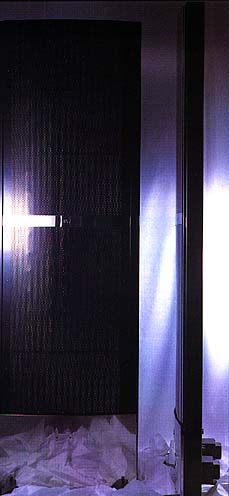
 CZAR
CZAR
CZAR
.....................
1. FUTURE PROOF: The modular construction allows for future upgrades
in panel technology (film, insulation, screen spacing, and angle of dispersion),
High Voltage Power Supply technology and audio transformer technology.
2. HIGH EFFICIENCY: THE first electrostatic "reference speaker"
which can easily be powered by Valve amplifiers with as little as 35 watts
of power or solid stte amplifiers with 50 watts of power.
4. INBUILT SUBWOOFER: Unlike other 'reference' speakers which require
satellite subwoofer sytems, the CZAR is able to reproduce low frequencies
(-3dB point approximately 25 Hertz when fully broken in) without any sonic
sacrifice. The sound is consistant in quality from 30 Hertz up to 45 kiloHertz
because we use the same 13 micron polyester film
4. WIDE DYNAMIC RANGE: By dividing the full range panel at around 150
Hertz from the subwoofer panels, the CZAR is able to generate over 120dB
of acoustic pressure from 50Hz - 45kHz (at ultra-low frequencies of 15-20Hz,
the spacing/film excursion limits the dynamic range to approximately 100dB
reproduction at 40Hz).
COMPOSITION
SCREENS:
Each speaker is made up of a single full range electrostatic screen
(24")
The screen stators are manufactured from copper-plated (6N) epoxy composite
board which is precision drilled and etched to remove the copper from the
edge boundaries of the holes. There are over 7000 holes drilled perfectly,
to within 1 micron which require two hours to drill. The panels are then
etched and coated and ultimately finished. A pair of CZAR consists of 8
panels which require on average 6 hours per panel to bring it to its finished
state.
It is only by producing the stators in this way that we avoid the typical
insulation problem inherent in electrostatics using perforated steel. The
uneven insulation coating at the hole edges which requires more insulation
build up, reduces the available gap spacing- decreasing efficiency and
low frequency response.
The stators are supported by a welded steel frame which is either epoxy-coated
or chrome-plated and can be sand-filled for additional mass. The combination
of epoxy stator, special acrylic tapes and steel frames cancel any ringing
- that would otherwise be present. If you simply tap the frames you will
hear a dull thud rather than a 'ring'.
The copper is sealed using high voltage resistant two- pot epoxy coatings
which is further coated with a proprietory formula. Then the whole panel
is two- pot epoxy coated for a lustrous 'piano black' finish.
Copper is preferred to steel as a conductive stator material because of
its sound purity and excellent conductivity.
POLYESTER FILM
Our Polyester film was selected after 5 years of experimentation with various
types and grades of film. The earliest electrostatic designs used mylar
with a rubbed on graphite powder to retain the high voltage charge (QUAD).
Then came experimentation with conductive printer's ink .
Lately, almost all electrostatics have been using polyester which is covered
with a fine metallic film (normally used as solar insulation for windows).
All these methods are still prone to absorbing moisture because the particles
are simply glued with water base adhesives to the surface.
The CZAR uses a proprietory film which uses a fine stainless steel spray
of particles using a solvent based adhesive which is not affected by humidity.
If it is forced to arc, a small area of the film coating is sacrificed
to avoid any further damage . Even with 90% of the panel sacrificed, it
would still function with a minor loss of efficiency.
A special high conductivity adhesive is used to connect the copper strip
to the polyester film coating to allow the best long term electrical contact
which cannot be dislodged over time.
SPACING AND TENSIONING
The CZAR allows us to divide the conflicting requirements of small gap (1.6mm)
between screens and film for optimal treble performance and larger gap (3.0mm)
necessary to accomodate the maximum excursions at subwoofer frequencies
of the bass panels by using special 'spacer materials' and relying on the
'arc' to space the panels apart from the vertical middle (which acts as
the treble/midrange) to the extreme outer edges which act as subwoofers.
Tensioning is accomplished by hand using the same technique employed to
tension the diaphragm of a musical instrument (tympani, drum etc). After
one week of constant operation, the complete panel is heat treated to ensure
the tightness of the diaphragm before shipping.
It is recommended that the speaker is used constantly for at lease 6 months
to obtain its optimum modulus of elasticity. This translates to a significant
increase in efficiency, low level detailing and transparency.
SPEAKER FRAMES:
The individual steel frames used in the CZAR speaker are precision shaped
from welded steel to be ABSOLUTELY RIDGID under all circumstances. A small
radius is milled into the solid steel plates which create a fine arc- enough
to give a degree of extra ridgidity in the epoxy stators.
HIGH VOLTAGE SUPPLIES
By using the latest in polystyrene film capacitor technology in the treble
and polypropylene capacitors in the bass combined with ultra-high speed
rectifier diodes (35nanosecond), we are able to ensure that the High Voltage
supplies do not limit the low-level dynamic range and sonic resolution of
the EMPEROR.
NOTE: WARNING. THIS SUPPLY USES HIGH VOLTAGE WHICH CAN GIVE YOU A SHOCK.
NEVER WORK ON THE SUPPLY WHEN IT IS CONNECTED TO THE MAINS AND MAKE SURE
WHENYOU DISCHARGE THE HV SUPPLY (BY SHORTING THE HV TO EARTH WHEN THE SUPPLY
IS NOT CONNECTED TO THE MAINS) BEFORE DOING ANY WORK ON THE SUPPLY.
AUDIO TRANSFORMERS
The art of winding Audio Transformers for electrostatic speakers or valve
amplifiers is missing from today's mainstream transformer manufacturers.
The transformer used in the CZAR are very special proprietory devices, totally
handwound and designed by a leading Australian audio transformer fanatic
after experimentation with over one hundred prototypes.
There are essentially three major factors which are inter related when designing
audio transformers. Unfortunately, all are conflicting and therefore require
compromise. For example, to increase the bass response one must add more
windings, which increases the capacitance and inductance and hence decreases
the treble response.
After coming up with the best compromise for impedance, capacitance, inductance
and gain, we set about experimenting with various transformer metals to
increase the power transfer before saturation. By using very expensive low
loss metal in our transformer stack, we are able to minimise the typical
dynamic compression of electrostatics. Because of this, the CZAR speed and
attack is reminiscent of horn type studio loudspeakers.
TREBLE TRANSFORMER: Our treble transformers use some very special
techniques. Firstly, we use 5 strands of Litzen wire for our Primary and
3 strands of Litzen wire for our Secondary windings. The inductance is minimised
by our 'heroic' use of 18 sections of windings to cancel out any stray inductance.Stray
capacitance and voltage breakdown is avoided by using 'double-insulated'
polyurethane coatings on OFC copper. This enables us to produce a transformer
which is PHASE PERFECT to well over 20KHz into a capacitive load of 1000pF.
Without the load, the frequency response is flat to beyond 200KHz.
BASS TRANSFORMER: By using every means to increase the absolute inductance,
we are able to produce a flat phase response to as low as 3Hz! The high
frequency roll-off starts at 5KHz, which is well beyond the 150Hz active
filter roll-off. This also allows us to add up to 6 extra bass panels per
side using the same transformer and power supply.
OPERATION
Biamplifier Operation: This is the recommended way to use the CZAR which
can be achieved in a number of ways:
*Using the phase linear active crossover supplied wire this in series with
the bass amplifier and use the volume pot supplied to match the overall
gain of the system for the bass section.
*For the Treble Section: Simple creating a 6dB/octave network by inserting
a capacitor in series with a full range amplifier input according to:
Ft (-3dB turnover frequency) = 1/ 2 pi (3.14) x R (amplifier
input impedance) x C (Capacitor in series).
Example: For an amplifier with an input impedance of 10 KOhms, and
we want the low frequencies to roll off from around 200Hz, the equation
becomes:-
200 = 1/2 x 3.14 x 100.000 x C
therefore C = 1/200 x 2 x 3.14 x 100.000
C = 7.96 x 10 power - 9 Farad
C = 7.96 nanFarad or 7.960 picoFarad
The closest value is approximaely 8.200 pico Farad which is available in
high quality polystyrene to minimise sound quality deterioration.
*Using an active crossover for both bass and treble (this is not the best
sonic solution because all active crossovers auditioned affect the sound
quality significantly).
12. TECHNICAL FAULT SERVICING
If you have any problems, we suggest you FAX us immediately to discuss exactly
what could be causing these problems. Because of the sheer simplicity of
construction, and modular approach used in the CZAR, faults are easy to
rectify.
(a) Arcing: If the speakers are arcing, it could be that there is some foreigh
matter dislodged between the film and speaker screen. Once this is 'burnt'
is should cuase no further problem.
(b) Losing Efficiency: Check the voltage supply voltages to ensure that
it is connected to the AC mains, or that a diode is not damaged.
(c) Panel Flapping: (TO BE CARRIED OUT BY MAS SERVICING AGENT ONLY) Using
a hairdryer, gently apply some heat (approx 1 - 2 feet away) in brushing
strokes until the slack is taken up
FULL-RANGE SPECIFICATIONS: Efficiency: 94dB/W/metre,
POWER HANDLING: 100WATTS music power.
FREQUENCY RESPONSE: 80Hz-35kHz +/- 3dB (room dependant below 60Hz).
DYNAMIC RANGE: 115dB.
STEP-UP TRANSFORMER: 100:1 ratio. 18 individual sections wound clockwise/anticlockwise
to reduce overall capacitance. Six (6) Ohm primary impedance. 300 Ohm secondary
impedance. Bifilar wound with double-polyurethane coated AUSTRALIAN COPPER
wire Litzen. Low-loss grain-oriented steel laminations on a 200 WATTS E-I
core. Totally handmade, wound and assembled.
SUBWOOFER BASS PANEL SPECIFICATIONS: Efficiency: 90dB/W/metre,
POWER HANDLING: 100 Watts program.
DYNAMIC RANGE: 100dB 40Hz-100Hz
[The Company | Unique Technology | Products
| Coming Soon]
Contact Us!

home!