 |
|
|
|
| |
|
 3 channel IR remote control 3 channel IR remote control
5-July-2005
www.sixca.com
This project is a 3-channel IR remote control
with 3 output
relay and easy to build.
Feature :
- CPU PIC12F629 at 4MHz crystal for Tx/Rx
- 3 channel output relay
- The Tx use sleep mode for saving battery power
- Use Phillips RC5 protocal
- distance more than 7 m.
- Easy circuit to build and assembly
- small components
Basic
RC5 protocal
The RC5 is probably the most used
by hobbyists, probably because the wide availability of cheap
remote controls and
easy to understand.
Feature :
- 2 start bit always "1"
- 1 toggle bit but this project not use and always "0"
- 5 bit address and 6 bit command length
- Bi-phase coding (aka Manchester coding)
- Carrier frequency of 36kHz 25-50% duty cycle
- Bit time period about 1.67 ms
- Developt by Philips
The protocol uses bi-phase
modulation (or Manchester code) of
a 36kHz IR carrier
frequency. All bits are of equal length of about 1.67 ms as
follows figure.
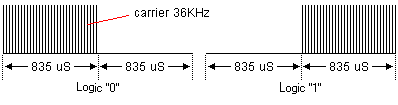
Figure 1. RC5 Modulation

Figure 2. RC5 Frame
format  Figure 3.
Bi-Phase coding
In figure 2,the first two
pulses are the start pulses, and are both logical "1". (St1
and St2)
The 3d bit is a toggle bit. This bit is
inverted every time a key is released and pressed again. But
this project not use this bit
and always "0" (Ctrl)
The next 5 bits represent the IR device address, which
is sent with MSB first. (S0-S4)
The next 6 bits is
command and sent with MSB first too.(C0-C5)
Note that
a RC5 frame consists of a total of 14 bits so the
total
time is about 23 mS
RC5 detecting
When the detect
subroutine is called, it first waits for a start bit. The
length of the low part of the first start bit is measured. If
the low pulse of first start bit is longer than 1.020 ms or
less then 800 uS the routine returns indicating error or no
command received.
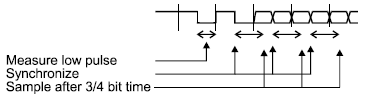 Figure 4. Synchronizing and Sampling of the
Data Figure 4. Synchronizing and Sampling of the
Data
The measurement of the start bit is
used to calculate two reference times, ref1 and ref2, which
are used when sampling the data line. The program uses the
edge in the middle of
every bit to synchronize the timing.
3/4 bit length after this
edge, the line is sampled. This
is in the middle of the first half
of the next bit (see
Figure 4).The state for each bit is stored and the routine
waits for the middle edge.
Tx
schematic
The TX use 8 pin PIC devices, here is
PIC12F629 run at 4 MHz
crystal. Actualy, this device has
4MHz RC internal oscillator but
not suitible for use with
the project that need cirtical time as
remote control.The
36KHz carrier and information bit generated by IC1.For saving
power when use with battery powered we
need to use this
device in sleep mode when any keys not
pressed and draw
current <1 mA at 4MHz, 5.5V .
Example how to wake-up
from sleep mode when key pressed. main : SLEEP
BTFSS CH1
GOTO Do_CH1
BTFSS CH2
GOTO Do_CH2
BTFSS CH3
GOTO Do_CH3
GOTO main
Rx
schematic
The IR was recieved from Tx will
demodulated by IC2 that is IR receiver Modules for Remote
Control Systems.In this project I
use TSOP4836 from Vishay
Semiconductors that is one of TSOP48XX series. After IR
demodulated it was decoded the protocal by IC1 then turn
on/off appropiate channel.The out out of IC1 is toggle every
time when Tx send the same command to Rx.You may be change the
output drive circuit for
suitible with your load.The pin 3
of IC1 must pull-up to vcc with
R10K becuase it is not has
weak-up internal pull-up.
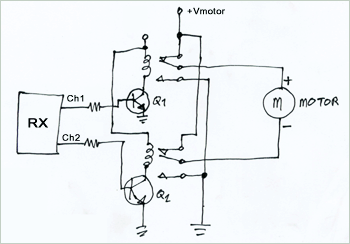
Here is an example application for
reverse direction of dc motor
Note : don't
for got to connect diode cross relay
Download
source
| |
|
|
|